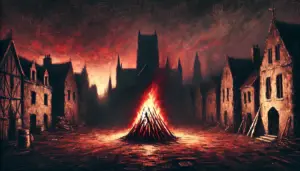
 She was trembling. The vaults were damp and cold, and they had given her nothing with which she could cover her nakedness. The sounds were horrifying, echoing through the dark dungeon with a metallic clatter and distant thuds. In this world of shadows and screams, sounds always meant approaching pain and despair.
She rolled over, filled with fear and cold, toward the wall on her bedding of wet, filthy straw. It was winter in the year 1463, and it was cold – but the cold and the noises reaching her ears in the darkness were not the worst of it. Far worse were the humiliation, the torture she had to endure, and the uncertainty of how much longer this would go on. She had no illusions about her end. Too often she had already been the witness of the cruel spectacle accompanied by the cheers of the townsfolk. Too often she had seen friends turn away when faith struck again.
It had been four days since the armed men, alongside the agents of the Inquisition, broke down the door of her small, decrepit hut in the forest, dragging her outside with kicks and blows. It was one of those quiet, contemplative moments – she had been sitting on her crude furniture, listening to the whispers of the wind, to the way it broke through the trees and played around her home – when they came to take her away. She had to watch helplessly as they ransacked her belongings, took what they deemed valuable, and set the rest, along with her house, on fire. Her past turned to smoke. Nothing of her would remain. And she was even more helpless when the thugs dragged her, bound, before the high officer. All her begging, pleading, and crying only seemed to fuel their rage.
Now she lay here, on a thin and filthy layer of straw, humiliated and tortured – without hope.
When she closed her eyes, memories came back to her of that time which now seemed so far away: when she sat safely and at peace in her shabby little hut, listening to nature, drying and processing her herbs, and when, every now and then, someone came seeking her help after the church’s medicine and prayers had failed. She lived alone, a little outside the village, and hardly anyone really knew her – she was an outsider since her husband had died some years earlier.
And to find a new partner, or even friends? Unthinkable. She had long given up on such ideas, for she was a person only a mother could love: her left leg was crippled after an accident, leaving her with a limp. She also bore a long scar across her face, a reminder of the night when she had refused to please her lord. But she was used to the loneliness. As a child, she had been shunned by everyone, labeled a changeling, chased off when she tried to play with the other children. After all, she was a bastard. She didn’t know her father, and her mother had barely regarded her as more than an afterthought.
When her old master had beaten her half to death for her refusal, she fled. The rickety hut she now called home had been built with her husband, whom she met on the run, and together they lived in it over the years. They had lived a peaceful life, taking only what the forest provided and tending to a small field behind the house. It wasn’t much, but they had rarely known real hunger.
Injuries, fevers, and pains they had learned to heal with herbs and plants collected and dried from the forest. Over time, word spread that an herbalist lived there who could help when everything else had failed. This knowledge had been in high demand in the recent weeks, for many had come to her sick. Some she could help, others not, but she had always tried and never asked for anything in return.
“Witch!”
No explanation of the charges, no idea of who had accused her, and no chance to defend herself. That one word was accusation, judgment, and cruel destiny all at once.
For weeks, people in the villages had been dying. Many people. Despite all the prayers, all the burned incense, and all the promises of the church. It was a terrifying time, and someone had to be to blame. The people wanted action, and who was easier to accuse than a lonely old woman who lived in a drafty hut, known by so few?
It was inevitable. A delegation of the Inquisition had conveniently arrived, and the high lord inspected the cases personally. He listened to the accounts of grieving relatives, interrogated villagers, and eventually her name and her doings came up. His logic was irrefutable, as was his word: “Only God can heal, and those sorcerers who are in league with the Devil! Behold your dead – this is the price you pay!”
She was a witch, one who consorted with the Devil. Before the high lord, she was not allowed to respond to the accusations. She wasn’t even permitted to lift her gaze for fear they’d be cursed. Everything they accused her of, they called out horrific acts she had never committed: kissing a goat’s behind, consorting with the Devil, participating in ceremonies where the flesh of small children was consumed. She was also accused of cursing the village and killing countless inhabitants with her curse. When the inquisitor asked her if she would confess, and she refused, a blow to her back sent her whimpering to the ground. The holy man asked her two more times if she would admit to her crimes, and when she did not, they led her to the dungeon.
“Confess, witch – save your soul so it won’t be cast into eternal damnation!”
The voice was loud and commanding. It was bizarre: the men with crosses stood right next to her. These were the same men who preached about Christianity and God’s love, yet here they were, bloodthirsty creatures from the deepest circles of Hell. One of the men nodded, and the henchman who had bound and prepared her tightened the ropes, turned the screws, and pressed the glowing iron onto her skin.
More horrid scenes lay ahead, but by the end, the tortured woman had whispered confessions – anything to end the pain…
The Inquisition moved on, to the next place – confident that the curse had now been broken and that no one else would fall victim to the mysterious plague. The witch was dead, and so were her accomplices. Yet the curse remained and grew worse, now that no one was left who understood the healing powers of the herbs.
The first to die were the children, those already weak and sick before her execution. The children she could have helped with her medicine. After them, many of their loved ones followed them to the grave.
And a cold wind swept over the fields full of crosses, but its song was heard only by those who had not laughed at the death of the innocents. For everyone else, it was merely the grave wind that carried the plague …